Introduction
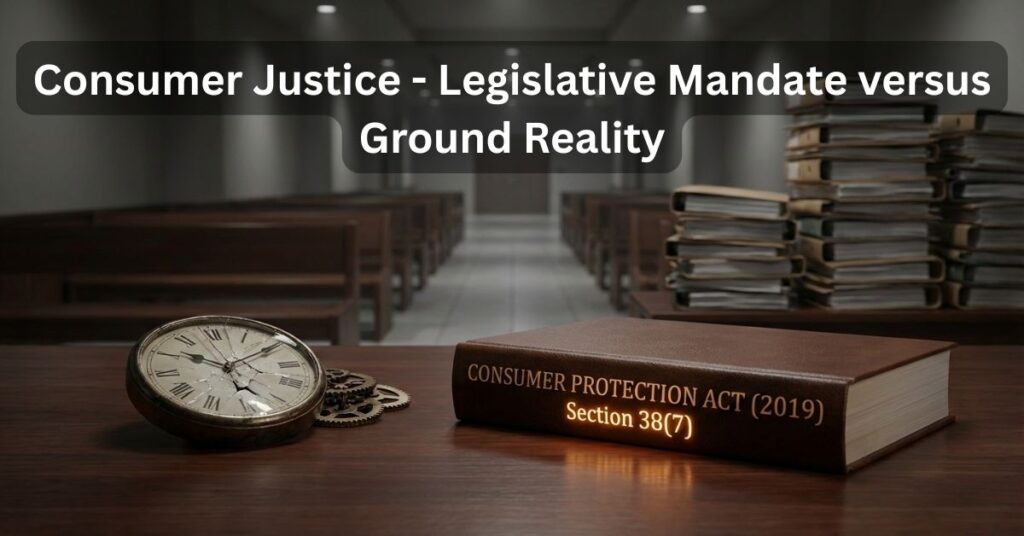
The Consumer Protection Act, 2019 was introduced as a beacon of legislative intent to provide consumers with “simple, inexpensive and speedy remedy” for their grievances. Yet, despite robust legal frameworks and explicit executive directives, the adjudication of consumer disputes continues to be plagued by systemic delays that fundamentally undermine the Act’s protective purpose. This article examines the stark disconnect between legislative mandates and enforcement realities, particularly focusing on the underutilized provisions of Section 38(7) and the persistent failure to adhere to prescribed timelines.
Legislative Framework and Guiding Directives
Section 38(7) of the Consumer Protection Act, 2019, mandates that every complaint shall be disposed of “as expeditiously as possible” with endeavours to decide complaints within three months from the date of receipt of notice by the opposite party, or within five months if analysis or testing of commodities is required. This statutory mandate is unambiguous in its intent to prevent the very delays that currently characterize consumer dispute resolution.
The Department of Consumer Affairs (DoCA) has repeatedly emphasized strict adherence to these timelines through comprehensive executive directions. In a Press Release dated 20 May 2022, the Department directed all Commissions not to grant adjournments beyond one month, stipulating that repeated adjournments should attract costs. This was reinforced by Union Minister Shri Piyush Goyal’s statement on 20 June 2022, where he stressed that consumer cases must be disposed of within 3-5 months, emphasizing that “justice delayed is justice denied“.[]
Recently, in 2022, Union Minister Shri Piyush Goyal emphasized the urgent need for expeditious consumer dispute resolution at a National Workshop on ‘Effective and Speedy Consumer Disputes Redressal‘. He stressed that Consumer Commissions should “religiously follow the timelines as per the Consumer Protection Act, 2019” and be able to dispose of cases within 3-5 months of filing to provide speedy justice to consumers. Highlighting the principle that “justice delayed is justice denied,” he urged extensive use of digital media including WhatsApp and e-mail for issuing notices, replies and other documents, and emphasized the importance of e-filing and e-disposal mechanisms.[]
Ground Reality
Despite these clear mandates, empirical data reveals a troubling reality. At the National Consumer Disputes Redressal Commission (NCDRC), pending cases doubled from 9,106 in 2017 to 18,273 in 2019.[] The situation has been compounded by an prevalent culture of adjournments that directly contravenes both statutory provisions and executive directives.
According to official sources, the average period between two hearings in the NCDRC is close to three months, while the Consumer Protection Act mandates that appeals should be disposed of within 90 days. The report reveals that 459 consumer cases, revision petitions and appeals have been pending with the NCDRC for more than a decade. Though there has been some improvement, with average adjournment days reducing from 112 days in 2019 to 88 days, this still falls far short of the statutory mandate.[] A comprehensive study by the Indian Institute of Public Administration highlighted that in 71.8% of cases filed before district commissions, adjournments, often granted for frivolous reasons, delayed proceedings. More alarmingly, in 25.6% of cases, such adjournments exceeded seven in number.[]
Another source reports that while the Act requires decisions within three months, based on complexities, matters typically take anywhere from 3 months to over 1 year. The actual timelines show significant deviation from statutory requirements: (i) District Consumer Forums: Judgment takes 6 months to 2 years; (ii) State Consumer Commissions: Judgment takes 1 to 3 years: (iii) National Consumer Commission: Judgment takes 1 to 5 years.[]
The Supreme Court has also provided crucial clarifications on timeline adherence in consumer disputes. The Constitution Bench in New India Assurance Company Limited v. Hilli Multipurpose Cold Storage Private Limited[] categorically held that consumer fora have no power to extend the time for filing responses beyond the statutorily prescribed period of 45 days. This decision established that the limitation periods under the Consumer Protection Act cannot be extended beyond statutory prescriptions. The Supreme Court has further clarified the application of this principle in subsequent decisions[] as well.
Systemic Challenges and Enforcement Gaps
The persistent delay problem stems from multiple systemic issues. Vacancy in consumer commissions significantly contributes to backlogs. Furthermore, delays under the guise of “adjournments” further compound this problem.
According to a report, former NCDRC members have identified that beyond staffing issues, “in many cases, the advocates seek adjournment. Ideally, there shouldn’t be more than one adjournment. We can’t let the consumer suffer for delay in decisions“[]. Such observations highlight the disconnect between legal practice and statutory mandate.
The Way Forward
The disconnect between legislative intent and ground reality requires immediate systemic reform. The statistics clearly demonstrate that despite executive directives from the Department of Consumer Affairs and constitutional principles established by the Supreme Court, consumer justice continues to be delayed at alarming rates.
Consumer commissions must be held accountable for compliance with Section 38(7) timelines through regular monitoring and reporting mechanisms. The promise of the Consumer Protection Act, 2019, to provide “simple, inexpensive and speedy remedy” remains largely unfulfilled due to systemic delays in adjudication. While Section 38(7) provides clear mandates for expeditious disposal, and executive directives from the Department of Consumer Affairs establish specific timeline requirements, ground reality shows persistent non-compliance.
Until enforcement of Section 38(7) becomes the norm rather than the exception, and until the adjournment culture is replaced by a disposal-oriented approach backed by strict accountability measures, consumer justice will continue to be delayed and, in many cases, effectively denied.
The legislative framework exists, executive directives are clear, and judicial pronouncements have established a mandate for expeditious disposal. What remains to be done is to execute the legislative intent and convert these mandates into ground reality through consistent enforcement and accountability mechanisms.
– Ankita Mishra, Associate, Solomon & Co.
About Solomon & Co.
Solomon & Co. (Advocates & Solicitors) was founded in 1909 and is amongst India’s oldest law-firms. The Firm is a full-service firm that provides legal service to Indian and international companies and high net-worth individuals on all aspects of Indian law.
“Disclaimer”
The information contained in this article is intended solely to provide general guidance on matters of interest for the personal use of the reader, who accepts full responsibility for its use. The application and impact of laws can vary widely based on the specific facts involved. As such, it should not be used as a substitute for consultation with a competent adviser. Before making any decision or taking any action, the reader should always consult a professional adviser relating to the relevant article posting.
Copyright © 2025 Solomon & Co., All rights reserved.