
An Overview of Real Estate Laws and Regulations Applicable in India

1. Overview A transaction in real estate in India must take into consideration: The Republic of India is a federation of 28 States and 8 Union Territories, and is governed by laws enacted and rules and regulations framed by: and Many Central legislations on subjects in the Concurrent List (e.g. registration of documents) have State amendments. Customary laws are applicable to the extent not inconsistent with the Constitution of India (e.g. Islamic Law is applicable to succession in the case of Mohammedans). For our responses, Central laws and laws applicable in the state of Maharashtra (of which the capital city is Mumbai) have been taken into consideration. Note that some laws differ from state to state and that local laws may also apply depending upon the type of transaction. In addition to central laws like RERA, buyers must also consider Indian state property restrictions, as each state has its own rules governing land ownership, usage, and transfer, particularly for agricultural and tribal lands. 2. What is the main legislation relating to real estate ownership? 3. How is ownership of real estate proved? Any transaction for transfer of interest in immovable property is required to be in writing and registered in the office of the “Sub-Registrar of Assurances”, subject to a few exceptions. A document of transfer of interest in immovable property which is compulsorily registrable but has not been registered is not admissible in evidence in civil proceedings. Registration of instruments which are required to be registered will constitute deemed notice to the public of the immovable property transactions which have been effected by such instruments. Most land holdings have been surveyed by government authorities and allotted a revenue survey number and issued a “Record of Right” (in case of agricultural lands in Maharashtra) or “Property Register Card” (in case of non-agricultural lands in Maharashtra) and similar documents in other parts of India. These revenue documents record the name of the original owner (at the time of first survey of the land by the government) and subsequent transfers as may have been notified to the authorities. The revenue documents provide prima facie evidence of ownership and devolution of title. Documents registered in respect of the property in the office of the Sub-Registrar of Assurances and documents issued by the revenue authorities are necessary steps for establishing the ownership of real estate. However, barring exceptions, an agreement for the transfer of immovable property or an interest therein (which does not itself operate to transfer any interest in land) is not required to be in writing or registered but a suit for specific performance of an unregistered agreement for sale of immovable property may be maintainable. Also, devolution of title on the demise of the owner and whether the names of all heirs of the deceased have been recorded in the revenue records, require consideration. 4. Are there any restrictions on who can own real estate? Persons resident outside India fall into the following three categories: (i) non-resident Indians; (ii) foreign nationals of Indian origin; and (iii) foreign nationals of non-Indian origin. (i) and (ii) can purchase or be gifted residential and commercial property (not agricultural land/plantation property/farm houses/private forest land which may only be inherited by (i) and (ii)). (iii) cannot purchase any immovable property in India unless such property is acquired by way of inheritance from a person who was resident in India. (iii) can, however, acquire or transfer immovable property in India, on lease, for a period not exceeding 5 years. A foreign company cannot acquire immovable property in India. However, a foreign company which has established a branch office in India may acquire immovable property in India which is necessary or incidental to its activity, subject to certain conditions. A foreign company which has established a liaison office in India cannot acquire immovable property in India, but can acquire property by way of lease, for a period not exceeding 5 years. A branch office is subject to taxation in India; a liaison office is not, because it cannot earn revenue in India. Foreign direct investment (“FDI”) into India is governed by the Consolidated FDI Policy. Investment can be made into an Indian company by subscribing to or acquiring instruments which are permitted, including equity shares, compulsorily convertible debentures, preference shares and certain other products available to foreign portfolio investors. External Commercial Borrowing is not permitted for investment in real estate or purchase of land, unless used for affordable housing, construction and development of Special Economic Zones and industrial parks/integrated townships. Under Indian law, a minor is not competent to enter into a contract. However, property can be acquired by a minor by inheritance or by the guardian for the minor or out of funds gifted to the minor. Transfer of immovable property during the minority of the holder can be effected with Court sanction. 5. What types of proprietary interests in real estate can be created? Freehold: Where the owners are dominant owners of the property in perpetuity with no obligation to make any payment to or seek consent from any other person and all other rights and interests in the property emanate from the owner. The absolute ownership of the owner is subject to some statutory restrictions e.g. on excavation and mining and extent of construction. Leasehold/Tenancy: Where the lessee/tenant has possession and use and income of the property for a fixed term or even in perpetuity, on condition that he pays rent and observes and performs the terms and conditions of the lease/tenancy, and the lessor/landlord has the right to terminate the lease/tenancy and take back possession, unless the lessee/tenant can claim protection from eviction under rent control legislation or the Transfer of Property Act. Licensee/Occupancy Rights: Where a person is permitted by the owner or by the lessee/tenant (provided the terms of lease/tenancy permit the lessee/tenant to do so) to carry on a specified activity on the property of the owner/lessee on specified conditions. Common Ownership: Where a building is owned by a Co-operative
Jurisdiction under Section 29A of the Arbitration and Conciliation Act, 1996: Reaffirming Statutory Discipline over Perceived Hierarchy
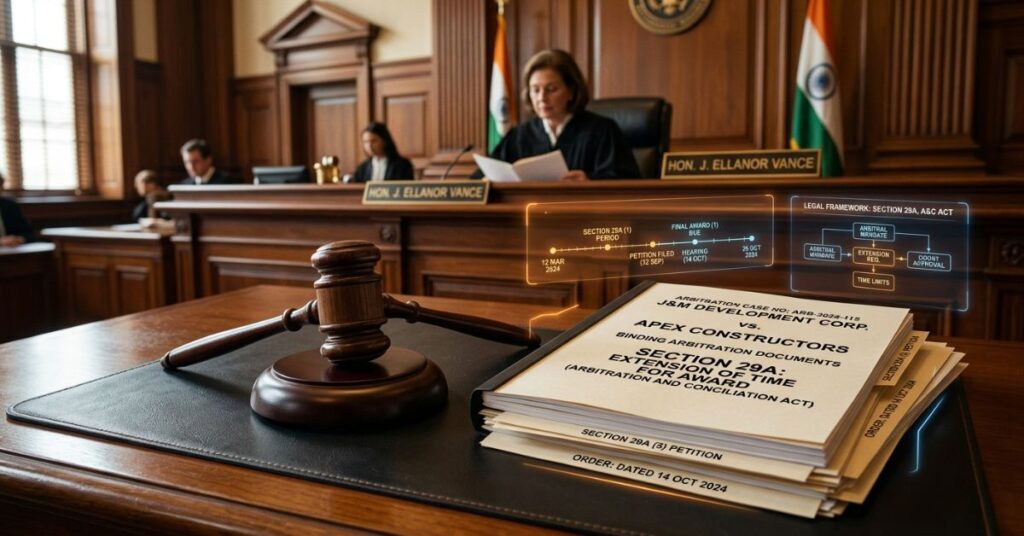
Authors: Mustafa Bohra & Divya Raut. Introduction The controversy in Jagdeep Chowgule v. Sheela Chowgule1 arises at the intersection of the appointment of arbitrators under Section 11 of the Arbitration and Conciliation Act, 1996 (the “Act”) and the curial control over arbitral timelines under Section 29A of the Act. At its core, the dispute concerns whether applications for extension or termination of an arbitral tribunal’s mandate under Section 29A are to be made exclusively to the “Court” as defined in Section 2(1)(e), or whether such applications lie instead before the High Court or Supreme Court which initially appointed the arbitrator under Section 11. This issue gained particular salience because divergent High Court decisions had created uncertainty on whether the appointing court retained any continuing supervisory jurisdiction over the arbitral proceedings after constitution of the tribunal, and whether a civil court or commercial court could validly extend the mandate of an arbitrator appointed by a constitutional court. In resolving this question, the Hon’ble Supreme Court reaffirmed the centrality of the statutory definition in Section 2(1)(e), which designates, in the case of non-international arbitrations, the principal civil court of original jurisdiction in a district, and includes High Courts exercising ordinary original civil jurisdiction, while expressly excluding courts of a grade inferior to such principal civil court and courts of small causes. The Court’s approach is consistent with its earlier emphasis that the Act is a self-contained code in which jurisdictional questions must be answered by reference to the statutory text and structure, rather than to general notions of convenience or institutional hierarchy. Read together with the Commercial Courts Act, 2015 under which arbitration related applications that would otherwise lie before the principal civil court are, in specified circumstances, channelled to designated Commercial Courts or Commercial Divisions. The Chowgule decision restores a coherent, statute-focused framework for determining the proper forum for Section 29A applications. Factual Background: The dispute arose from a Memorandum of Family Settlement dated 11th January 2021 between members of the Chowgule family. Arbitration was invoked under the settlement clause on 18th May 2021. During the pendency of arbitral proceedings, the presiding arbitrator resigned, prompting an application under Section 11 of the Act before the High Court, which subsequently appointed an arbitrator. Separately, owing to delay in completion of arbitration, an application under Section 29A of the Act seeking extension of time for making the arbitral award was filed before the Commercial Court. The Commercial Court allowed the application. This order was challenged before the High Court on the ground that, since the arbitrator was appointed by the High Court under Section 11 of the Act, the Commercial Court lacked jurisdiction to extend the mandate. The Single Judge referred the issue to a Division Bench due to conflicting High Court judgments on whether the “Court” under Section 29A of the Act refers to the Court defined in Section 2(1)(e) or the High Court/Supreme Court which appointed the arbitrator. The Division Bench held that jurisdiction depended on the mode of appointment of the arbitral tribunal. The Single Judge thereafter quashed the Commercial Court’s order. These decisions were challenged before the Hon’ble Supreme Court. Statutory Framework Favouring Civil Court Jurisdiction: The Hon’ble Supreme Court unequivocally held that the expression “Court” appearing in Section 29A of the Act must be construed strictly in accordance with the definition contained in Section 2(1)(e) of the Act. The Court reasoned that Section 2(1)(e) provides an exhaustive definition for the purposes of Part I of the Act and, in the absence of any express statutory departure, the same meaning must govern Section 29A of the Act. It was emphasised that the jurisdiction exercised by the Hon’ble High Court or the Hon’ble Supreme Court under Section 11 is special, limited and stands exhausted upon the constitution of the arbitral tribunal. Once an arbitrator is appointed, the appointing court becomes functus officio and does not retain any supervisory or controlling jurisdiction over the conduct of arbitral proceedings. The Court further observed that Section 29A forms part of Chapter VI of the Act, which deals with the making of the arbitral award and termination of proceedings, whereas Section 11 falls within Chapter III, which concerns the constitution of the arbitral tribunal. The legislative separation of these chapters reflects a conscious intent to segregate appointment-related functions from post-constitution curial supervision. The authority to extend the mandate of the tribunal or to substitute arbitrators under Section 29A of the Act is thus a curial function vested in the “Court” as defined in Section 2(1)(e), namely the Principal Civil Court of original jurisdiction or a High Court exercising ordinary original civil jurisdiction. The Hon’ble Supreme Court also reaffirmed that jurisdiction under arbitration law flows solely from statute and cannot be influenced by notions of institutional hierarchy or perceived superiority of courts. Contrary Judicial Approach in High Court Decisions: The contrary line of reasoning adopted by several High Courts proceeded on the premise that a contextual interpretation of Section 29A was necessary to avoid jurisdictional anomalies. These courts relied upon the opening words of Section 2(1) “unless the context otherwise requires” to hold that where an arbitrator is appointed by the High Court or the Supreme Court under Section 11, applications for extension of mandate under Section 29A must lie before the same court. The principal concern expressed was that permitting a Civil Court to extend the mandate or substitute an arbitrator appointed by a constitutional court would result in a conflict of powers and undermine judicial hierarchy. It was further reasoned that the power to extend time or substitute arbitrators under Section 29A is ancillary to the power of appointment under Section 11 and must therefore be exercised by the appointing court alone. Some decisions also expressed apprehension that allowing Section 29A applications before Civil Courts would dilute the exclusive jurisdiction principle embodied in Section 42 of the Act. Interpretative Reasoning of the Hon’ble Supreme Court: The Hon’ble Supreme Court decisively rejected the contrary approach, holding that perceived anomalies, institutional discomfort, or hierarchical
What are Personality Rights under Indian Jurisprudence

Author – Shruti Mehta Introduction: The law has long recognised that reputation has value. In modern commercial reality, however, identity itself has become an asset. A person’s name, image, voice, signature, likeness or distinctive traits may carry significant economic worth, particularly when associated with public recognition. The unauthorised commercial exploitation of such identity raises a fundamental question: does an individual have a proprietary interest in their persona? Indian law does not answer this question through legislation. There is no statutory provision that expressly defines or codifies “personality rights” or the “right of publicity.” Instead, the doctrine has evolved incrementally through judicial decisions. Courts have drawn from constitutional principles, common law remedies and intellectual property statutes to construct a framework that protects identity against commercial misappropriation. At the same time, this evolution has not been linear. While courts have expanded protection in cases involving endorsements and digital misuse, judicial commentary has also cautioned against converting fame into an absolute monopoly. Personality rights, therefore, occupy a delicate space between property, privacy and free speech. This article examines the conceptual basis, legal foundation and contemporary contours of personality rights in India. What are Personality Rights in India: Personality rights, in their broadest sense, refer to the right of an individual to protect and control the commercial use of their identity. The identity of a person is not confined merely to their name. It extends to attributes that uniquely identify them in the public domain, including their likeness, image, voice, signature, distinctive appearance and other recognisable aspects of persona. Where such attributes have acquired goodwill or commercial value, unauthorised use may result in economic exploitation and reputational harm. Indian courts have recognised that identity may constitute an enforceable legal interest. In ICC Development (International) Ltd. v. Arvee Enterprises the Delhi High Court observed that the right of publicity vests in an individual and that no entity can claim proprietary rights over a person’s identity without authorisation. The Court clarified that the right of publicity originates from the right to privacy and is inherent to the individual whose persona is sought to be commercially exploited. This decision is frequently regarded as one of the earliest judicial recognitions of publicity rights in India. The commercial dimension of personality rights was further articulated in Titan Industries Ltd. v. Ramkumar Jewellers where the Delhi High Court restrained the unauthorised use of images of well known personalities in an advertisement. The Court recognised that a celebrity has the right to control the commercial exploitation of their persona and that unauthorised use in advertising amounts to infringement of the right of publicity. The reasoning reflects judicial acknowledgment that identity, when associated with goodwill, functions as a valuable commercial asset. The constitutional foundation of personality rights is often traced to the right to privacy under Article 21 of the Constitution of India. In R. Rajagopal v. State of Tamil Nadu, the Supreme Court recognised that the right to privacy is implicit in the right to life and personal liberty. Although the case concerned, unauthorised publication of an individual’s life story, the Court’s recognition of autonomy over personal identity laid the groundwork for subsequent development of publicity-based claims. Different Kinds of Personality Rights: Personality rights in India have developed along two principal dimensions that emerge from both doctrinal synthesis and judicial practice. The first dimension is the right of publicity, which protects an individual’s ability to control and commercially exploit their identity. The second is the right to privacy, which protects an individual’s autonomy and personal sphere against unauthorised disclosure or misuse. These dimensions often overlap in practice, but they reflect distinct legal interests that justify differing legal responses. The right of publicity encompasses the right of an individual to prevent others from commercially exploiting their name, image, voice, likeness and other distinctive aspects of their persona without consent. As defined in academic literature, the right to publicity protects one’s identity, existence and likeness from being imitated and commercially appropriated by third parties without authorisation. This right springs from the recognition that personal identity may acquire economic value beyond its source, particularly where the individual’s reputation has achieved public recognition or goodwill. The right of publicity is thus grounded in the protection of economic interests arising from persona as a marketable commodity, making it analogous to intellectual property rights in function if not in textual origin. In contrast, the right to privacy seeks to protect the individual’s personal zone of autonomy against intrusive exposure or dissemination of personal information. The Supreme Court’s recognition of privacy as a fundamental right under Article 21 in Justice K.S. Puttaswamy (Retd.) v. Union of India confirmed the constitutional basis upon which privacy related personality claims rest. In the context of personality rights, the right to privacy ensures that an individual’s name, image or likeness is not used in ways that nvade their personal life or reveal intimate aspects of their identity without consent. Privacy-based personality protection thus functions independently of commercial exploitation and protects the dignity of individuals, irrespective of their fame or public status In practice, these two dimensions often converge. A celebrity’s voice or likeness used in an unauthorised advertisement without consent would implicate both privacy and publicity interests, as the disparagement of personal autonomy and economic exploitation coincide. Similarly, digital misappropriation of a person’s identity through AI generated content implicates not only commercial harm but also intrusion into the personal sphere of representation. While the right of publicity prioritises commercial control, the right to privacy safeguards the personal sanctity of identity, and Indian jurisprudence continues to develop these streams to address the multifaceted harms associated with misuse of persona. The Growing Need of Personality Rights in India: The need for personality rights in India arises from the intersection of evolving commercial realities, technological advancements and constitutional values. Identity today functions as a tradable asset in ways that were unimaginable in earlier legal frameworks. The widespread use of digital media has transformed personal identity into a commodifiable resource, capable of generating significant revenue
Digital Succession in the Modern Age

Author – Shruti Mehta Introduction: Succession law has historically operated within a framework of tangible property and clearly identifiable proprietary interests. The Indian Succession Act, 1925 contemplates movable and immovable property capable of transmission upon death. However, the twenty first century has introduced a new category of assets that do not fit neatly within traditional classifications. Cryptocurrency holdings, monetised online platforms, domain names, cloud stored manuscripts, digital art, subscription-based businesses and online investment accounts now constitute a substantial portion of modern estates. Alongside these commercially valuable assets lie deeply personal digital records such as emails, photographs, private communications and social media accounts. Collectively, these form what may be termed a digital estate. The legal difficulty arises because Indian law does not yet contain a coherent framework governing succession to digital assets. The Digital Personal Data Protection Act, 2023 (“DPDP Act”) introduces the concept of a digital nominee under Section 14, empowering a nominated person to exercise rights of access, correction and erasure. At the same time, the Indian Succession Act, 1925 governs devolution of property upon legal heirs. The central issue therefore is whether digital nomination displaces or coexists with inheritance. In other words, when a person dies leaving behind digital assets, does control vest in the nominee, or does beneficial ownership devolve upon legal heirs? The Nature and Scope of Digital Inheritance within the Scope of Indian Succession Framework: Digital inheritance refers to the transmission of control, access or ownership of digital assets from a deceased person to successors. Unlike traditional property, digital assets are intangible, often encrypted, and frequently governed by contractual Terms of Service imposed by service providers. These agreements may restrict access even to family members unless prior consent mechanisms exist. Digital assets may broadly be classified into three categories. First, personal communication assets such as emails, cloud documents and private messages. Second, financial digital assets such as cryptocurrency wallets, online banking accounts and digital investment platforms. Third, commercially valuable digital property including monetised social media channels, domain names, proprietary software, digital intellectual property and customer databases. The legal complexity lies in the distinction between ownership and licence. Many digital assets, such as e-books and subscription-based software, are licensed rather than owned. A licence is ordinarily non-transferable unless expressly permitted. However, cryptocurrency, domain names and digital intellectual property are capable of ownership and transmission. The failure to distinguish between licensed digital access and proprietary digital value creates uncertainty in succession disputes. The Indian Succession Act, 1925 governs testamentary and intestate succession. While the Act does not explicitly refer to digital assets, its reference to movable property is sufficiently broad to include intangible property. In principle, commercially valuable digital assets should devolve upon heirs in the same manner as bank deposits or shares. However, the absence of express statutory recognition has practical consequences. Service providers often require succession certificates, probate or court orders before granting access. In cases involving foreign headquartered platforms, cross jurisdictional complications arise. Unlike bank accounts governed by domestic regulation, digital platforms operate under private contractual frameworks that may not readily recognise Indian succession documents. Although. the Information Technology Act, 2000 regulates electronic records but does not address postmortem access. As a result, heirs are frequently dependent on the discretion of corporations rather than a structured statutory entitlement. This legal vacuum creates both economic risk and emotional hardship. The Right to Nominate Under the DPDP Act: Section 14 of the DPDP, 2023 permits a data principal to nominate another person to exercise data rights upon death or incapacity. The nominee may seek access, correction or erasure of personal data. The legislative purpose is to ensure continuity of data governance and prevent digital stagnation. However, the provision does not address ownership of digital assets. It neither declare that the nominee becomes the successor in title nor does it clarify the relationship between nominee rights and inheritance under succession law. The Act is fundamentally concerned with personal data processing, not proprietary devolution. The jurisprudence on nomination in India is instructive. In Sarbati Devi v. Usha Devi, the Supreme Court held that nomination does not confer beneficial ownership unless expressly provided by statute. The nominee receives property as a trustee for legal heirs. Similarly, in Union of India v. Paresh Chandra Mondal, the Court reiterated that disbursement to a nominee does not override succession rights. Applying these principles, a digital nominee under Section 14 should be understood as a custodian of data rights rather than the beneficial owner of commercially valuable digital assets. Moreover, the characterisation of digital assets as property is not merely theoretical. Indian courts have recognised cryptocurrency as a form of property capable of being possessed and enjoyed. Intellectual property rights are inheritable under the Copyright Act, 1957. Domain names and online businesses are treated as valuable commercial assets in civil disputes. Article 300A of the Constitution protects the right to property and prohibits deprivation except by authority of law. If digital assets embody economic value, they form part of the estate and are protected from arbitrary extinguishment. A nominee exercising erasure rights over commercially valuable digital assets may inadvertently destroy estate property, thereby prejudicing heirs. The conflict becomes particularly pronounced where a digital asset is both personal and commercial in character. For instance, an unpublished manuscript stored in a cloud account is personal in authorship but commercially valuable as intellectual property. If a nominee exercises erasure in such a case, the destruction affects inheritable copyright interests. The apparent conflict between legal heirs and digital nominees must be resolved through doctrinal coherence. Nomination, unless expressly dispositive, does not displace inheritance. Section 14 of the DPDP Act should therefore be interpreted as granting regulatory authority over personal data, not proprietary entitlement over estate assets. A principled distinction must be drawn between personal digital data and commercially valuable digital assets. Purely personal communications may legitimately fall within the nominee’s control consistent with privacy considerations. However, assets that possess measurable economic value should devolve in accordance with succession law. Legislative reform would provide certainty. The Indian
Introduction of documents in evidence and the intricacies involved therein

Introduction: It is settled law that when one files a suit, the Plaint should be accompanied by all documents that are essential to prove one’s case. On the same lines, a defendant is also required to ensure that all documents relied on are annexed to his written statement. But what happens when you come across a crucial document after filing the Suit or the Written Statement. Can you add it to your existing case? The answer is yes. In this article we will discuss the legal provisions which allow a party to add additional documents to his case. After the filing of the pleadings, if for any reasonable cogent reason certain essential documents are not annexed to the plaint/ written statement and the same are discovered at a later date, the Plaintiff under Order VII Rule 14 (3) and the Defendant under Order VIII Rule 1A(3) of the Civil Procedure Code, 1908 (“CPC”) can seek leave of the court to produce the documents. Order VII Rule 14(3) “(3) A document which ought to be produced in Court by the plaintiff when the plaint is presented, or to be entered in the list to be added or annexed to the plaint but is not produced or entered accordingly, shall not, without the leave of the Court, be received in evidence on his behalf at the hearing of the suit.” Order VIII Rule 1A(3) “(3) A document which ought to be produced in Court by the defendant under this rule, but, is not so produced shall not, without the leave of the Court, be received in evidence on his behalf at the hearing of the suit.” Upon a bare perusal of the provision, it becomes evident that documents which remained to be produced can be brought on record \with the leave of the court. However, what the provision does not answer is under what circumstances can this leave be granted by the court?. The time frame within which this application must be made?Whether the court may grant leave to produce all documents? Whether the court will allow all applications filed under this provision or is it a discretionary right? Whether the court can allow leave to produce documents which are unstamped or where there are allegations of forgery? Analysis: Power of court to grant leave to produce additional documents in evidence is one of a procedural nature. The intent of procedural law is to ensure that substantial justice is done. It is hence a basic requirement that when the parties approach the court under the aforesaid provisions to show their bonafides and intent. When the intent of the parties backed by malice or delay the court may not be inclined to grant such a leave. In the case of Haldiram Pvt. Ltd. & Ors. Versus Haldiram Bhujiawala & Anr. the Plaintiff had filed an application under Order VII Rule 14(3) for production of additional documents. In this particular case the court had analysed that the suit was of 1991 and the same was strongly contested between the parties. Since the institution of the suit there were multiple interim applications filed. Hence, when the application to produce additional documents amounting to 14 volumes was filed in 2009 the same was rejected by the trial court on the grounds that the documents that were sought to be added were infact in possession of the Plaintiff for quite some time and in the peculiar facts of the case there was no reason why the same were not produced before. The Hon’ble trial court further noted that the same was being done with an intent to solely delay the proceedings. Hence, the Hon’ble Court had denied the application. It can hence be conferred that (a) the right to produce documents is a discretionary right available with the court and cannot be granted in all circumstances and (b) the parties must approach the court att he earliest possible instance, any undue delay may lead to rejection. Recently the Hon’ble Supreme Court of India in the case of Muruganandam v. Muniyandi, had dealt with the issue of whether unstamped and unregistered agreement can be allowed to be produced in evidence?. The Plaintiff in this case was denied by the trial court his right to produce the agreement for sale whose copy was already annexed to the plaint. The grounds for the same as analysed by the trial court was that the reason to not produce the original document is not convincing and that the agreement was unstamped and unregistered. The Hon’ble Supreme Court of India while overturning the decision of the trial court had analysed the proviso to Section 49 of the Registration Act alongwith Order VII Rule 14(3) of CPC and allowed the Plaintiff to introduce the unregistered agreement for sale and lead oral evidence but at the same time had left it open for the Respondents to contest the relevancy and validity of the document as permissible in law and left it open for the trial court to pass appropriate orders. The intent of the court in this proviso is not only to afford genuine parties another chance but also to help court so that substantial justice is done. So what happens when parties use this provision to seek leave to produce documents which may be forged?. In the case of Bhagwani Devi Mohata Hospital v A.D.J. Rajgarh & Anr. the petitioner had sought to produce documents at a belated stage during evidence. The contentions raised were that such documents were forged and concocted. The Hon’ble Court had in this case decided that these allegations regarding forgery of documents can be decided once both the parties are given the chance to prove or disprove the document. Hence it was noted that there was no error in law or jurisdiction in allowing the Plaintiff to place on record these documents. From the aforesaid, it can be analysed that the parties are at liberty to produce the following documents: It also becomes apparent that not all applications
Modern Ipr Piracy in the Digitalized Pivotal Era: Indian Law and Global Trends

Author: Anand Patel, Senior Associate What Is Intellectual Property Piracy? Intellectual Property Piracy refers to the unauthorized duplication, reproduction, distribution sharing, sale, or use of creations protected by intellectual property laws. These may include copyrighted content, patented inventions, branded logos, proprietary software, and confidential trade information. The internet has amplified the scale and anonymity of infringement, making it easier to access pirated content such as software, movies, music, books, and logos without consent or legal authorization. With technological advancements like peer-to-peer sharing, torrent sites, and cloud storage, enforcing IPR laws has become increasingly complex. When individuals or organizations utilize such protected assets without proper authorization or legal rights, they infringe upon the owner’s exclusive privileges. How Does IP Piracy Take Place? The forms and channels through which intellectual property is pirated have grown more sophisticated, especially due to the accessibility of technology and online platforms. Below are the most common avenues of IP piracy: Digital piracy: In today’s digital and globalized era, piracy takes on multifaceted and often highly organized forms, both online and offline. One of the most prevalent methods is digital piracy, which involves unauthorized downloading, streaming, or sharing of digital media such as films, music, television shows, e-books, and software. These acts are often facilitated through torrent websites, illegal streaming platforms, file-hosting services, and social media channels, where infringing content is made available at zero or minimal cost to the consumer.The stance of digital piracy of unauthorized streaming of movies was extensively laid out in the cornerstone judgement of 1UTV Software Communications Ltd (2019), wherein The Delhi High Court dealt with eight suits filed by the international film production company against several websites, accused of streaming and offering downloads of copyrighted films without authorization. The issue of dealing with online piracy was laid out through a comprehensive measure of blocking such piracy websites and servers via, Site Blocking, The Domain Name System (DNS) Name Blocking, Deep Packet Inspection (DPI) Based Blocking etc. This judgment provides a fundamental approach in dealing with modern age IPR Piracy and ways to combat such piracy for the purpose of establishing a secured future for the IPR Holders not only in the real world but also in the digital arena. “THE GENERAL INDUSTRY EVIDENCE APPEARS CONSISTENT WITH A HYPOTHESIS THAT DIGITAL PIRACY HAS HURT THE MOVIE INDUSTRY. IN FACT, ONLINE PIRACY HAS HAD A VERY REAL AND TANGIBLE IMPACT ON THE FILM INDUSTRY AND RIGHTS OF THE OWNERS.” “However, the focus of copyright enforcement and website blocking is on sites that facilitate large-scale copyright infringement—such as those that have many full-length movies, TV shows, and songs—so even if the IP address used by a piracy site hosts non- infringing pages or files, the legitimate content that is blocked is small, and not reason enough to avoid shutting down the website. If The Pirate Bay or KickAssTorrents facilitated access to a small amount of content that had a creative commons license, and was therefore able to be shared, this would not change the fact that it is a piracy site worth shutting down.” Patent infringement: Another avenue of piracy wherein an invention protected under patent law is exploited without authorization. This often occurs through reverse engineering or unauthorized production and sale of patented items on digital platforms and online marketplace, leading to massive losses for innovators and companies that have invested in research and development. Trademark piracy: Involves using logos, names, or designs similar to registered trademarks to mislead consumers on digital platforms, websites, and torrent apps. This results in deceiving the consumers along with diminishing the goodwill of certified trademarks. The mere purpose of this is profit maximization and revenue generation upon the mimicry of market reputation, product, goodwill, brand image, of well-known trademarks. The Delhi High Court recently on 28th July 2025 in the matter of “2Ferrero Spa & Ors V. M.B. Enterprises” laid out the intricacies concerning the deceitful usage of well-known trademarks, while defining its purpose and recognition. “35. a ‘well-known trademark’, as per the provisions of Section 2(zg) and Section 11(6)7 of the Act, the said trademarks ‘NUTELLA’/ of the plaintiffs have to be such that they have become so well-known to a substantial segment of the public that its use on other goods or services is likely to indicate a connection between those goods or services and the person using the mark in relation to the first-mentioned goods or services. In order to ascertain such declaration, the factors that need to be considered inter alia are knowledge or recognition obtained by way of promotion of the said trademark, duration, extent and geographical area of use. 29. As such, if the defendant is allowed to continue under such circumstances, it is likely to result in causing utter confusion, lead to deception and cause damage amongst the members of the public at large as also to the long well-established goodwill and reputation of the plaintiffs as well.” Software piracy: This includes the unauthorized use, duplication, or distribution of software, often via cracked versions, illegal installations, or counterfeit licenses. Common methods include softlifting (installing one licensed software on multiple devices), hard disk loading (pre-installing pirated software on sold devices), and the use of key generators or activators. Another troubling domain is academic and creative plagiarism, where individuals reproduce another’s, content be it academic papers, blogs, designs, or multimedia without appropriate attribution, thereby violating moral and copyright rights. Platforms like blogs, personal websites, or freelance portals often harbor such plagiarized content. Peer-to-peer (P2P) file-sharing networks such as BitTorrent also serve as a hotbed for piracy, where users simultaneously download and upload files without central oversight, making enforcement difficult and enabling wide-scale infringement. Rise of mobile app piracy: has seen the proliferation of cracked or modified APK files, where paid apps or games are distributed for free via third-party websites, bypassing app store licensing protocols. These apps often unlock premium features illegally, impacting developers ’revenue streams. Finally, unauthorized use of images, code, video content, or articles from copyrighted websites often termed
Arrest Procedures Under Scrutiny: Hon’ble Supreme Court Of India Clarifies When Failure To Inform Grounds Of Arrest Vitiates Custody

Author: Divya Raut, Associate An arrest constitutes one of the gravest intrusions into personal liberty permitted under Indian Constitutional Law. It marks a point at which the coercive authority of the State most directly confronts the individual. Accordingly, arrest cannot be treated as a routine step in investigation, but as an exceptional measure that must strictly confirm to the safeguards prescribed by the Constitution of India and applicable statutory framework. The Supreme Court of India has consistently affirmed that the power of arrest is not an unfettered executive discretion, but a regulated power subject to close constitutional and judicial scrutiny. The recent decision in Mihir Rajesh Shah v. State of Maharashtra1 marks a significant reaffirmation and consolidation of this constitutional position. The judgment brings doctrinal clarity to the scope, content and consequences of the obligation to inform an arrested person of the grounds of arrest, anchoring it firmly within the guarantees of Articles 21 and 22 of the Constitution. Article 22(1): A Substantive Constitutional Guarantee Article 22(1) of the Constitution mandates that no person who is arrested shall be detained in custody without being informed of the grounds of arrest or be denied the right to consult a legal practitioner of their choice. As clarified by the Hon’ble Supreme Court in Mihir Rajesh Shah (Supra), this protection is not a procedural embellishment but a substantive right flowing directly from the guarantee of personal liberty under Article 21. The Court has reiterated that the purpose of informing the grounds of arrest is to place the arrested person in a position to meaningfully exercise legal remedies particularly to oppose remand and seek bail. Any interpretation that reduces this obligation to a formality would defeat the constitutional object underlying Article 22(1). Universality of the Obligation A crucial contribution of Mihir Rajesh Shah lies in his rejection of a fragmented approach to constitutional safeguards. The Court reaffirmed that the obligation to inform grounds of arrest applies uniformly across all arrests, irrespective of whether they arise under the Bharatiya Nyaya Sanhita 2023 or under special statutes. The judgment expressly disapproved the notion sometimes advanced in enforcement practice that enhanced safeguards are relevant only in cases involving stringent statutes such as the Prevention of Money Law Act, 2000 or Unlawful Activities (Prevention) Act, 1967. Fundamental rights, the Court reiterated, do not fluctuate based on legislative labels or the perceived gravity of the offence. They adhere to the individual, not to the statute under which the arrest is made. This reasoning aligns with the deeper constitutional principle that State power cannot be immunised from constitutional scrutiny by legislative design. Statutory Reinforcement under Bharatiya Nagarik Suraksha Sanhita, 2023 The Bharatiya Nagarik Suraksha Sanhita, 2023, reinforces constitutional guarantees by codifying arrest safeguards. Section 47 of Bharatiya Nagarik Suraksha Sanhita, 2023 mandates that the arresting officer shall forthwith communicate the full particulars of the offence or the grounds of arrest. Section 48 of Bharatiya Nagarik Suraksha Sanhita, 2023 supplements this by requiring immediate intimation of arrest to a relative or nominated person. In Mihir Rajesh Shah, the Supreme Court clarified that these provisions are not standalone statutory rights, but legislative instruments intended to operationalise Article 22(1). Consequently, non-compliance with Bharatiya Nagarik Suraksha Sanhita arrest provisions does not remain a mere statutory irregularity it acquires a constitutional dimension. This interpretation elevates statutory arrest procedures from administrative guidelines to enforceable constitutional obligations. Mode of Communication: Meaningful, Not Mechanical While Article 22(1) does not expressly prescribe the mode of communication, the Supreme Court has clarified that the mode must be such as to effectively serve the constitutional purpose. In Mihir Rajesh Shah, the Court held that communication of grounds of arrest must be meaningful, intelligible, and capable of being utilised for legal defence. Drawing upon earlier precedent, the Court noted that mere oral intimation particularly at the moment of arrest may not satisfy this requirement. Furnishing the grounds of arrest in writing is therefore not treated as a rigid technical mandate but as the most reliable method to ensure effective compliance and avoid factual disputes regarding communication Timing and Limited Flexibility The expression “as soon as may be” has been interpreted by the Court to allow limited flexibility only in genuinely exigent circumstances. In Mihir Rajesh Shah, the Court acknowledged that situations may arise where it is not practically feasible to immediately furnish written grounds such as arrests effected during the commission of a serious offence. However, the Court cautioned that such situations cannot be normalised. The obligation to communicate the grounds subsists and must be fulfilled at the earliest possible opportunity. Administrative convenience or investigative urgency cannot justify routine deviation from constitutional requirements. Consequences of Non-Compliance The Supreme Court has reaffirmed that failure to communicate the grounds of arrest strikes at the root of the constitutional guarantee under Article 22(1). An arrest effected in breach of this requirement is unlawful and continued custody based on such arrest is constitutionally unsustainable. Importantly, the Court clarified that subsequent events such as filing of a charge- sheet or grant of remand cannot cure the illegality arising from an unconstitutional arrest. This principle underscores the duty of magistrates to independently verify compliance with arrest safeguards at the remand stage. Practical Implications The judgment carries far-reaching implications for the criminal justice system: The decision reinforces that constitutional compliance is not adversarial to effective investigation; rather, it legitimises State action and preserves public confidence in the justice system. Conclusion This reasoning aligns with the deeper constitutional principle that State power cannot be immunised from constitutional scrutiny by legislative design. The constitutional law of arrest rests on a simple but profound principle: liberty cannot be curtailed without accountability. Communication of the grounds of arrest is the earliest and most visible expression of that accountability. As reaffirmed in Mihir Rajesh Shah v. State of Maharashtra, this obligation is non- negotiable, statute-neutral, and central to the rule of law. The transition to the Bharatiya Nagarik Suraksha Sanhita framework does not dilute constitutional protections it reinforces them. In an era of
Speedy Trademark Decisions As A Fundamental Right In Rajasthan High Court: What The Case Says And How Applicants Can Handle Delays

Author: Anand Patel, Senior Associate Anyone who has filed a trademark in India knows the feeling. You file the form. You wait. An objection arrives or an opposition is lodged. You answer. Then nothing happens for months or even years. That long pause is not just frustrating. It delays approvals for packaging and labelling, stalls marketing calendars, and holds up distributor onboarding and marketplace listings that require proof of rights. It affects valuations during investor due diligence and can slow credit, insurance, and contract signoffs that turn on brand certainty. It increases the risk of parallel use and dilution, weakens interim enforcement, and complicates domain name and social handle disputes. It forces businesses to carry inventory and design costs with a real possibility of rebranding later, which disrupts SKUs, barcodes, and IT systems. It consumes management time and legal budgets without advancing the matter toward resolution. In practical terms, prolonged administrative inaction creates concrete prejudice to commercial planning and to the legal rights associated with the mark. A recent order of the Rajasthan High Court speaks directly to this problem. In Nirmala Kabra v Registrar of Trade Marks, the Court said that getting a timely decision on a trademark application is not only a matter of good administration. It is part of the right to life under Article 21 of the Constitution. The Court also told the Registrar to move on all pending applications as early as possible and to decide the petitioner’s case within three months. This piece explains the case in simple terms. It sets out what the Court relied on in the Trademarks Rules. It notes the debate that followed. It ends with practical steps you can use if your file is stuck. The Problem the Court saw The petitioner applied to register the mark “Breastone” on 25 June 2010. An opposition came in on 7 March 2013. Pleadings finished. The matter was listed for recording of evidence on 25 July 2017. After that, the file went quiet for more than eight years. The petitioner then asked the High Court for directions to the Registrar to take a decision. These dates appear both in the case report and in the order. The Court pointed to Rule 50 of the Trade Marks Rules, 2017. This rule says that once evidence is closed, the Registrar must give notice of the first hearing date. The hearing should be at least one month after that notice. Each party can seek an adjournment by filing TM-M at least three days before the hearing, but the maximum is two adjournments, and each adjournment cannot exceed thirty days. In short, the Rules are designed to keep hearings and decisions moving. What the Court held The Court found that the prolonged pendency in the petitioner’s matter was egregious and incompatible with the framework of the Trade Marks Rules, 2017. It held that such delay defeats the mandatory discipline of Rule 50, under which hearings must follow promptly after the close of evidence and adjournments are strictly limited. The Court explained that long delays prejudice both sides, because evidence becomes stale, costs escalate, commercial planning is impaired, and confidence in the adjudicatory process erodes. Those consequences amount to a denial of natural justice, since statutory procedures must be conducted fairly and within a reasonable time. The Court further held that the right to a speedy and expeditious decision on trademark applications flows from Article 21 of the Constitution. On that basis, it directed the Registrar to decide the petitioner’s application within a fixed period and to deal with other pending matters as early as possible. It also required the Registrar to put in place a strategy for clearing the backlog and for ensuring adherence to the timelines contemplated by the Rules. Why Rule 50 matters Delay is not an inevitable feature of opposition proceedings. Rule 50 provides a structured timetable. Once evidence closes, the Registrar must issue a hearing notice for a date that is at least one month after the notice. Each party may seek at most two adjournments, and each adjournment cannot exceed thirty days. The Rule contemplates written submissions and culminates in a reasoned order. These are not aspirational statements. They are binding procedural requirements designed to prevent drift. When Rule 50 is observed in letter and spirit, matters do not linger for years without a hearing or decision. The Debate: Should Article 21 be used here? The judgment has prompted discussion among scholars and practitioners. One view is that enforcing the Trade Marks Rules was sufficient and that the matter could have been resolved squarely as a question of administrative law, without invoking Article 21. Another view is that the constitutional framing is appropriate because the Supreme Court has long recognised a right to speedy justice, and that principle can guide administrative adjudication where the legislature has already prescribed time-conscious procedures. Regardless of theory, the practical effect is clear. The decision reinforces that prolonged inaction after the close of evidence is unacceptable and invites judicial intervention. What Applicants and Opponents can do now Request a hearing after evidence closes. If evidence has concluded and no hearing notice has issued, parties should write to the Registry and request that a hearing be fixed and the matter be decided. The request should refer to Rule 50 and to the High Court’s directions on timely disposal. The representation should be concise, factual, and supported by a brief chronology. Use adjournments sparingly and correctly. Each side has a maximum of two adjournments of up to thirty days each, to be sought in the prescribed form and within the prescribed time. Parties should plan their case calendars with this ceiling in mind and avoid routine postponements. File focused written submissions. Short and issue-driven written arguments help the hearing officer and reduce the need for further rounds. They also ensure that the principal points are on record even if oral time is limited. Consider expedited processing early. Where timing is critical, parties may consider applying for expedited
THE LAW OF MITIGATION

Introduction “In estimating the loss or damage arising from a breach of contract, the means which existed of remedying the inconvenience caused by the non-performance of the contract must be taken into account.” (emphasis supplied) What does taking reasonable steps mean in the context of mitigation of losses? Duty to mitigate : a statutory mandate or not? Conclusion Nikhilesh Koundinya, Senior Associate, Solomon & Co. About Solomon & Co. Solomon & Co. (Advocates & Solicitors) was founded in 1909 and is amongst India’s oldest law-firms. The Firm is a full-service firm that provides legal service to Indian and international companies and high net-worth individuals on all aspects of Indian law. “Disclaimer” The information contained in this article is intended solely to provide general guidance on matters of interest for the personal use of the reader, who accepts full responsibility for its use. The application and impact of laws can vary widely based on the specific facts involved. As such, it should not be used as a substitute for consultation with a competent adviser. Before making any decision or taking any action, the reader should always consult a professional adviser relating to the relevant article posting. Copyright © 2026 Solomon & Co., All rights reserved.
Practical Implications of Interim Compensation in Negotiable Instruments Act Proceedings

Introduction The Negotiable Instruments Act, 1881 (“NI Act”) was enacted to regulate the law governing promissory notes, bills of exchange, cheques, and similar negotiable instruments. Over time, these instruments, particularly cheques, have become integral to business transactions, offering a convenient and reliable method for transferring funds. With the growth of the banking system, cheques evolved into an essential tool for monetary exchange, not only between individuals but also in the broader commercial sphere. However, the widespread use of cheques also led to certain challenges, particularly the practice of dishonouring cheques. This situation became grim when drawers issued cheques without maintaining sufficient funds in their accounts, leading to distrust in the banking system and the negotiable instruments themselves. In response, to safeguard the interests of the creditors and maintain confidence in the banking system, Sections 138 to 142 of the NI Act were introduced. In 1988, the Banking, Public Financial Institutions, and Negotiable Instruments (Amendment) Act was passed, incorporating Chapter XVII to the NI Act, thereby introducing penalties for the dishonour of cheques. This amendment aimed to address the issue of dishonoured cheques due to insufficient funds, ensuring that creditors could have legal recourse to recover amounts due. This was further strengthened by the Negotiable Instruments (Amendment and Miscellaneous Provisions) Act, 2002, which introduced Sections 143 to 147 to expedite the resolution of such cases and help in boosting the confidence of the creditor. Issue of prolonged litigation Despite these legislative provisions, increase in the number of cheque dishonour cases under Section 138 of the NI Act, coupled with the backlog of pending cases, created a significant issue for creditors. As of 2024, approximately 43 Lakh cases related to cheque dishonour under Section 138 were pending in courts, contributing to the huge backlog of criminal cases. This delay in resolving disputes implied that creditors often had to endure long periods before receiving the fine or compensation imposed upon the accused, even in cases where cheques had been issued in payment of legitimate dues. The legislature, therefore, sought to address this issue by introducing provisions for interim compensation during the pendency of Section 138 proceedings. Introduction of Sections 143A and 148 of the NI Act In response to the aforementioned challenges, the Negotiable Instruments (Amendment) Act, 2018 introduced two important provisions: Applicability of Sections 143A and 148: Prospective vs Retrospective The Supreme Court of India has discussed and explained the applicability of these provisions, specifically addressing whether they should apply prospectively or retrospectively. In G.J. Raja vs. Tejraj Surana, the Court held that Section 143A, due to its provision for interim compensation before the accused is found guilty, should apply prospectively. The Court reasoned that applying it to offences committed before the amendment could unfairly penalize the accused for actions predating the legislative change. However, in Surinder Singh Deshwal vs. Virender Gandhi, the Supreme Court interpreted Section 148 to be retrospective. The court noted that, unlike Section 143A, which applies at the trial stage, Section 148 applies at the appellate stage after the accused is found guilty under Section 138 of the Act. Judicial Interpretation of “May” vs “Shall” The discretionary nature of interim compensation under Section 143A and Section 148 has been a subject of judicial interpretation. In Surinder Singh Deshwal vs. Virender Gandhi (supra), the Supreme Court interpreted the word “may” in Section 148 to mean “shall”, thus making interim compensation mandatory unless specific reasons for non-deposit are recorded by the appellate court. Conversely, in Jamboo Bhandari vs. M.P. State Industrial Development & Ors , the Supreme Court clarified that Section 143A remained discretionary. Since this provision applies before the conviction of the accused, trial courts must assess the prima facie merits of the complainant’s case, the defence raised by the accused, and factors such as the financial condition of the parties before awarding interim compensation. Ultimately, the Hon’ble Supreme Court cleared the ambiguity related to the mandatory or discretionary nature of S. 143 in its judgement in the case of Rakesh Ranjan Shrivastava vs. The State of Jharkhand & Anr and held that power to grant interim compensation in cheque bounce cases under sub-section (1) of Section 143A of the Negotiable Instruments Act, 1881 (N.I. Act) is discretionary and not mandatory. Conclusion The 2018 amendments to the Negotiable Instruments Act represent a significant shift in the way cheque dishonour cases are handled in India. By introducing provisions for interim compensation under Section 143A and appellate relief under Section 148, the legislature aims to protect creditors from the prolonged delays in judicial proceedings and restore faith in the use of negotiable instruments, especially cheques. Through these reforms, the NI Act remains a crucial element in fostering a trustworthy, efficient, and secure business environment in India, thereby strengthening the country’s commercial landscape and ensuring that business transactions are fair, transparent, and timely.
