Authors: Anand Patel, Senior Associate
Introduction
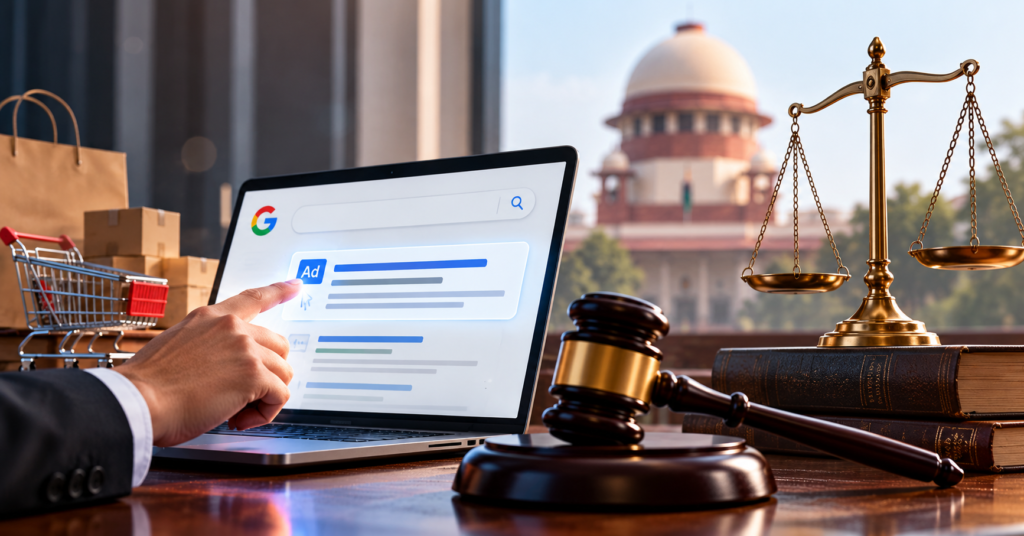
Trademark law was earlier easier to understand in physical terms. If someone copied another person’s brand name on packaging, signboards, labels, visiting cards or advertisements, the infringement was visible. The brand owner could see it, collect evidence and take action. Digital advertising has changed this completely. A trademark may now be misused without appearing on the face of an advertisement at all. A competitor can use another company’s registered trademark as a hidden keyword on Google Ads. When a consumer searches for the original brand, the competitor’s sponsored result may appear first. The consumer may not know why that competitor’s result appeared. But behind the screen, the original brand name has been used to attract that consumer.
This is the core issue in Hindware Ltd. v. Grohe India Pvt. Ltd. & Ors. and the connected suit involving Google. The Delhi High Court’s judgment is important because it recognises that trademark misuse can happen invisibly in the digital advertising process. The Court held that the use of the registered trademark “HINDWARE” as a keyword in Google’s advertising programme amounted to use of the mark in advertising and, on the facts of the case, amounted to trademark infringement.
The judgment matters not only for large companies like Hindware or Google. It is important for every brand owner whose business depends on online visibility. Today, customers search for brands on Google, YouTube, Facebook, Instagram, IndiaMART, Amazon, Myntra, app stores and other platforms. If another party is allowed to use a registered trademark as a keyword, tag, sponsored listing trigger or backend search term, the customer may be diverted before even reaching the real brand owner.
We have seen this issue in practice. In one matter, a client’s registered trademark was being used as a search keyword. When users searched for our client’s brand, the infringer’s website appeared instead of the client’s website. A cease-and-desist notice was issued, and complaints were also filed with Google, YouTube, Facebook and other platforms separately. Similar issues also arise on IndiaMART and other marketplace platforms, where competitors use another party’s mark in listings, product titles, tags or paid promotions to capture search traffic.
This raises a simple question: if platforms such as Amazon and Myntra can ask sellers for trademark registration or brand authorisation before allowing them to list products under a brand name, why should search and advertising platforms not have stronger checks before allowing advertisers to use another person’s registered trademark as a keyword?
The Hindware judgment answers this question in a practical way. It says that digital advertising platforms cannot always hide behind the argument that the keyword is invisible or that the advertiser alone is responsible.
Background of the Dispute
Hindware is a well-known sanitaryware brand. The plaintiff is the registered proprietor of the trademark “HINDWARE”, used in relation to sanitaryware and bathroom products. The mark had been used for many years and was earlier recognised by the Delhi High Court as a well-known mark in HSIL Limited v. Kripton Ceramics Pvt. Ltd. & Ors.1
The dispute arose because competitors of Hindware, including Grohe and Cera, had used “HINDWARE” and related expressions as keywords in Google’s AdWords programme. Because of this, when a user searched for “HINDWARE”, “HINDWARE SANITARYWARE”, or similar terms on Google, sponsored results of competing brands appeared prominently.
During the course of the proceedings, Grohe and Cera settled with Hindware. The main contest then continued against Google India and Google LLC. Hindware’s case was that Google was not merely a passive platform. According to Hindware, Google was offering, suggesting, permitting, auctioning and monetising the trademark “HINDWARE” as a keyword to third-party advertisers, including direct competitors.
Google defended itself by saying that a keyword is only a backend trigger. It argued that the keyword is not visible to the consumer and therefore cannot amount to trademark use. Google also argued that it is an intermediary and should be protected under Section 79 of the Information Technology Act, 2000, the argument which the Court rejected.
1CS (OS) 2736/2014
The Main Issue: Is Hidden Keyword Use Also Trademark Use?
The most important issue before the Court was whether the invisible use of a registered trademark as a keyword can amount to “use” under trademark law. Google’s argument was simple: the consumer does not see the keyword. The word “HINDWARE” may be used in the backend, but if it does not appear in the final advertisement, there is no trademark use.
The Delhi High Court did not accept this narrow view. The Court relied on Section 29(6)(d) of the Trade Marks Act, 1999, which says that a person uses a registered trademark if he uses it “uses the registered trade mark on business papers or in advertising”. The Court made an important distinction between “in advertising” and “in an advertisement”.
This distinction is very important. “In an advertisement” would mean only the visible advertisement shown to the public. But “in advertising” is wider. It covers the whole advertising process. This includes keyword selection, bidding, ad triggering and sponsored result placement.
Therefore, even if the trademark does not appear in the final ad text, it can still be used “in advertising” if it is used to trigger a sponsored advertisement.
This finding is important because digital advertising works largely behind the screen. The user only sees the result. The real commercial action happens through keywords, algorithms, bidding systems, quality scores and platform-controlled ad placement. If trademark law only protects visible misuse, it will fail to address how online advertising actually works.
Google Was Treated as an Active Commercial Participant
Another major part of the judgment is the Court’s finding on Google’s role. Google tried to present itself as a platform where advertisers choose their own keywords. But the Court looked deeper into the advertising model. Google Ads is a commercial programme. It permits advertisers to bid on keywords. It suggests keywords through tools. It decides how ads are displayed. It earns revenue when users click sponsored links.
The Court therefore treated Google as an active participant, not merely a passive notice board. The Court noted that Google was making commercial use of the trademark by allowing it to be used as advertising inventory. In simple words, Google was allowing a competitor to use Hindware’s brand value to attract customers, and Google was earning from that process.
This is one of the strongest parts of the judgment. It moves the discussion away from only the advertiser’s liability and brings the platform’s role into focus. If a platform suggests keywords, permits bidding on brand names, ranks sponsored ads, and earns money from clicks, it cannot simply say that it has no responsibility.
This has wider implications for all digital platforms. The same logic may be relevant to marketplace ads, app store ads, social media ads and sponsored product listings where a platform is not merely hosting content but actively selling visibility.
Why the Nature of the Mark Was Important?
The Court also gave importance to the nature of the mark “HINDWARE”. It noted that “HINDWARE” is a coined word. It is not an ordinary dictionary word. It does not naturally describe sanitaryware products. Its commercial value comes from the reputation built by the trademark owner.
This is important because all keyword cases are not the same. A case involving a coined or invented mark is stronger than a case involving descriptive or common words. For example, a word that describes a product category may be harder to monopolise in search advertising. But where the word is a distinctive brand name, using it as a keyword is more likely to be seen as taking unfair advantage.
In the Hindware case, the competitors were also in the same business. They were not using “HINDWARE” for commentary, comparison, review or information. They were using it to appear before customers who were looking for Hindware products. This made the case stronger for infringement.
Section 29(8): Unfair Advantage and Honest Practices
One of the most useful parts of the judgment is the Court’s analysis under Section 29(8) of the Trade Marks Act. Section 29(8) says that a registered trademark is infringed by advertising of that trademark if the advertising takes unfair advantage of the mark, is contrary to honest commercial practices, is detrimental to the distinctive character of the mark, or is against the reputation of the mark. The Court held that Google’s conduct amounted to taking unfair advantage of Hindware’s mark. The reasoning is straightforward. Hindware had spent years building its brand. Consumers searched for Hindware because of its goodwill. Google then allowed competitors to use that exact brand name as a keyword to show their own sponsored advertisements. This helped the competitors attract customers who were looking for Hindware. Google also earned revenue from such clicks.
The Court treated this as free-riding. The benefit of the reputation built by Hindware was being used by others without permission. The Court also observed that Google could not sell or auction a trademark that it did not own.
This is a very important finding for brand owners. In many keyword cases, proving actual confusion may be difficult. A customer may not come forward and say that he was confused. But under Section 29(8), the focus is not only on confusion. The focus is also on unfair advantage, dishonest commercial practice and harm to the advertising function of the trademark.
The judgment therefore strengthens the position of trademark owners, especially where the mark is coined, distinctive or well known.
Rejection of Google’s Safe Harbour Defence
Google also claimed protection under Section 79 of the Information Technology Act, 2000. This provision gives safe harbour protection to intermediaries in certain situations. However, the Court held that Google could not rely on safe harbour in this case. The reason was that Google was not merely hosting third-party information. It was actively operating an advertising system, allowing bidding on trademarks, suggesting keywords and earning revenue from sponsored links.
Safe harbour is meant for passive intermediaries that follow due diligence. It cannot be used as a shield where the platform itself is commercially involved in the infringing activity. This finding is very relevant for future disputes. Platforms often argue that they are only intermediaries. But after Hindware, if a platform is actively involved in monetising trademark misuse, courts may not accept a simple safe harbour defence.
Comparison with Earlier Keyword Advertising Cases
The Hindware judgment must be read with earlier cases, especially Google LLC v. DRS Logistics (P) Ltd.2 In DRS Logistics, the Delhi High Court had already held that using a registered trademark as a keyword can amount to use in advertising. However, the Court also clarified that keyword use is not automatically infringement in every case. The facts will matter. Courts must examine whether there is confusion, unfair advantage, dilution or dishonest diversion. The Hindware judgment builds on DRS Logistics, but it is more relevant for brand owners for several reasons.
First, Hindware is a final judgment after trial. Evidence was led. Witnesses were examined. The Court considered the actual working of Google Ads and then granted final relief. This gives the judgment greater practical value than an interim-stage order. Second, the mark “HINDWARE” was a coined and well-known mark. This made the case much stronger than cases involving generic or descriptive expressions. Third, the competitors were in the same line of business. Therefore, the diversion was direct. A person searching for Hindware sanitaryware could be shown a competitor’s sanitaryware ad. Fourth, the Court did not merely say that keyword use can be trademark use. It went further and held that Google’s conduct amounted to infringement. It granted a permanent injunction, awarded nominal damages of Rs. 30 lakh and directed actual costs.
The judgment can also be compared with Google LLC v. MakeMyTrip (India) Pvt. Ltd. and Policybazaar Insurance Web Aggregator v. Coverfox Insurance Broking3 . In those matters, the Court took a more cautious approach because the marks involved words or combinations that could have dictionary or descriptive meaning. The Hindware Court distinguished those cases because “HINDWARE” was a coined and distinctive mark.
This is why Hindware does not mean that all keyword advertising is illegal. It means that where a strong registered trademark is used by a competitor as a keyword to divert traffic, the defence that the keyword is invisible will not work.
2 2023 SCC OnLine Del 4809
Link with Meta-Tag and Internet Trademark Cases
The judgment also fits into the wider line of Indian cases dealing with hidden online use of trademarks. In Satyam Infoway Ltd. v. Siffynet Solutions Pvt. Ltd4 ., the Supreme Court recognised that domain names are business identifiers and can be protected under passing off principles. This was one of the earliest important Indian decisions recognising that online identifiers have commercial value.
In People Interactive (India) Pvt. Ltd. v. Gaurav Jerry5 , the Bombay High Court dealt with the use of another party’s mark in meta-tags. Meta-tags are also not always visible to consumers, but they can affect search results and divert internet traffic. The Court treated such hidden use seriously.
Similarly, in Amway India Enterprises Pvt. Ltd. v. 1MG Technologies Pvt. Ltd6 ., the Delhi High Court considered hidden use of trademarks in the online environment. These cases show that Indian courts have been willing to look beyond visible copying and examine how internet users are actually diverted.
The Hindware judgment takes this reasoning further into paid search advertising.
3 2023 SCC OnLine Del 7965
4 2004 6 SCC 145
5 2014 SCC OnLine Bom 4607
6 2019 SCC OnLine Del 9061
Impact on Brand owners and platforms
The practical impact of the Hindware judgment is that brand owners can no longer look only for visible misuse of their marks, such as copied logos, fake websites, counterfeit listings or misleading social media pages. They now need to also watch the less visible ways in which their trademarks may be used online, including Google keywords, sponsored search results, marketplace tags, app store keywords, backend SEO terms, IndiaMART listings, Amazon or Myntra product tags, and paid advertisements on platforms such as YouTube, Facebook and Instagram. For brand owners, evidence collection will become very important. They should preserve screenshots showing the search term used, the sponsored result displayed, the date and time, the URL, the landing page, the seller details and the manner in which the mark is being used. Customer complaints showing confusion or diversion should also be saved. Once this evidence is collected, action should ideally be taken against both the advertiser or infringer and the platform, because stopping only one campaign may not be enough if the same misuse continues through another listing or advertisement.
The judgment is also a clear warning for advertisers, agencies and marketing teams that competitor trademarks should not be treated as easy traffic tools. Using another brand’s name as a hidden keyword or product tag may appear to be a quick marketing shortcut, but after Hindware, it carries a higher legal risk, especially where the mark is registered, distinctive or well known. Companies should therefore have an internal keyword policy and should not use competitor marks without legal review. If any comparison is made, it must be honest, clear and not misleading, and the advertisement must not suggest any connection, authorisation, dealership or association with the trademark owner. The judgment also raises an important point for platforms. If platforms like Amazon and Myntra can ask sellers for trademark registration or brand authorisation before allowing branded listings, then search engines, social media platforms and B2B marketplaces should also have stronger trademark checks before allowing a registered mark to be used as a paid keyword or sponsored listing trigger. In that sense, Hindware is not only about Google Ads; it is about the larger responsibility of digital platforms wherever they sell visibility based on brand searches.
Conclusion
The Hindware v. Google judgment is important because it brings trademark law closer to the reality of digital business. It recognises that a trademark can be misused even when it is not visible to the customer. In modern advertising, the real misuse may happen through keywords, algorithms, bidding systems and sponsored results.
The Delhi High Court has made it clear that invisible use is not automatically innocent. If a registered and distinctive trademark is used as a keyword to show a competitor’s advertisement, and if the platform actively permits, suggests or monetises that use, it can amount to infringement.
At the same time, the judgment does not ban all keyword advertising. It does not say that every use of a competitor’s name is illegal. Honest comparison, descriptive use and fair competition may still be permitted depending on facts. But using another company’s trademark as hidden digital bait to capture customers is now much riskier.
For brand owners, the message is clear: register the mark, monitor digital misuse, preserve evidence and act quickly against both infringers and platforms. For advertisers, the message is equally clear: build your own brand, avoid secret use of competitor marks and ensure legal review of paid search campaigns.
The judgment is therefore not only about Hindware or Google. It is about how trademark law must operate in a marketplace where the first point of customer contact is often a search bar.
Anand Patel, Senior Associate, Solomon & Co.
About Solomon & Co.
Solomon & Co. (Advocates & Solicitors) was founded in 1909 and is amongst India’s oldest law-firms. The Firm is a full-service firm that provides legal service to Indian and international companies and high net-worth individuals on all aspects of Indian law.
“Disclaimer”
The information contained in this article is intended solely to provide general guidance on matters of interest for the personal use of the reader, who accepts full responsibility for its use. The application and impact of laws can vary widely based on the specific facts involved. As such, it should not be used as a substitute for consultation with a competent adviser. Before making any decision or taking any action, the reader should always consult a professional adviser relating to the relevant article posting.
Copyright © Solomon & Co. 2026, All rights reserved.