Author: Anand Patel, Senior Associate
Introduction
Anyone who has filed a trademark in India knows the feeling. You file the form. You wait. An objection arrives or an opposition is lodged. You answer. Then nothing happens for months or even years. That long pause is not just frustrating. It delays approvals for packaging and labelling, stalls marketing calendars, and holds up distributor onboarding and marketplace listings that require proof of rights. It affects valuations during investor due diligence and can slow credit, insurance, and contract signoffs that turn on brand certainty. It increases the risk of parallel use and dilution, weakens interim enforcement, and complicates domain name and social handle disputes. It forces businesses to carry inventory and design costs with a real possibility of rebranding later, which disrupts SKUs, barcodes, and IT systems. It consumes management time and legal budgets without advancing the matter toward resolution. In practical terms, prolonged administrative inaction creates concrete prejudice to commercial planning and to the legal rights associated with the mark.
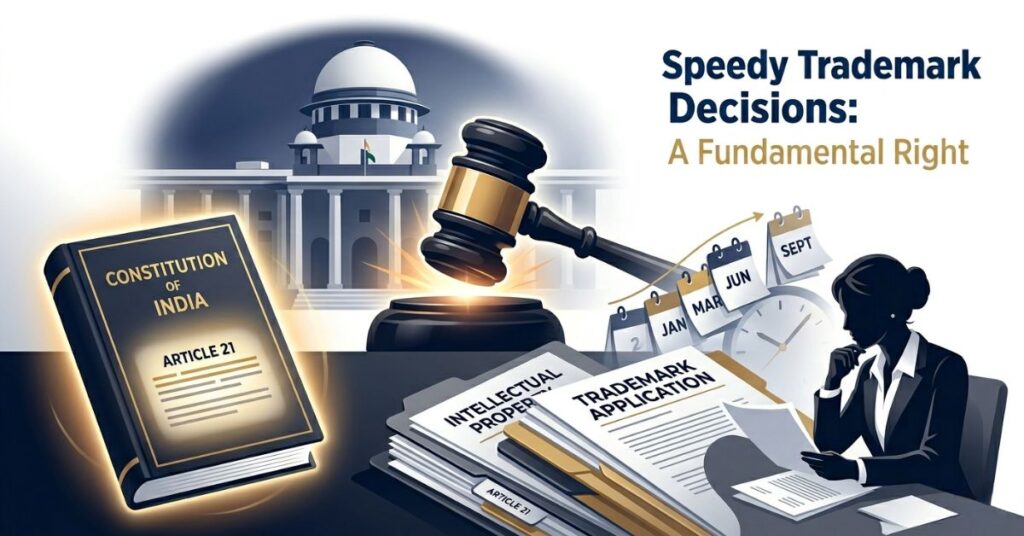
A recent order of the Rajasthan High Court speaks directly to this problem. In Nirmala Kabra v Registrar of Trade Marks, the Court said that getting a timely decision on a trademark application is not only a matter of good administration. It is part of the right to life under Article 21 of the Constitution. The Court also told the Registrar to move on all pending applications as early as possible and to decide the petitioner’s case within three months. This piece explains the case in simple terms. It sets out what the Court relied on in the Trademarks Rules. It notes the debate that followed. It ends with practical steps you can use if your file is stuck.
The Problem the Court saw
- The petitioner applied to register the mark “Breastone” on 25 June 2010. An opposition came in on 7 March 2013. Pleadings finished. The matter was listed for recording of evidence on 25 July 2017. After that, the file went quiet for more than eight years. The petitioner then asked the High Court for directions to the Registrar to take a decision. These dates appear both in the case report and in the order.
- The Court pointed to Rule 50 of the Trade Marks Rules, 2017. This rule says that once evidence is closed, the Registrar must give notice of the first hearing date. The hearing should be at least one month after that notice. Each party can seek an adjournment by filing TM-M at least three days before the hearing, but the maximum is two adjournments, and each adjournment cannot exceed thirty days. In short, the Rules are designed to keep hearings and decisions moving.
What the Court held
The Court found that the prolonged pendency in the petitioner’s matter was egregious and incompatible with the framework of the Trade Marks Rules, 2017. It held that such delay defeats the mandatory discipline of Rule 50, under which hearings must follow promptly after the close of evidence and adjournments are strictly limited. The Court explained that long delays prejudice both sides, because evidence becomes stale, costs escalate, commercial planning is impaired, and confidence in the adjudicatory process erodes. Those consequences amount to a denial of natural justice, since statutory procedures must be conducted fairly and within a reasonable time.
The Court further held that the right to a speedy and expeditious decision on trademark applications flows from Article 21 of the Constitution. On that basis, it directed the Registrar to decide the petitioner’s application within a fixed period and to deal with other pending matters as early as possible. It also required the Registrar to put in place a strategy for clearing the backlog and for ensuring adherence to the timelines contemplated by the Rules.
Why Rule 50 matters
Delay is not an inevitable feature of opposition proceedings. Rule 50 provides a structured timetable. Once evidence closes, the Registrar must issue a hearing notice for a date that is at least one month after the notice. Each party may seek at most two adjournments, and each adjournment cannot exceed thirty days. The Rule contemplates written submissions and culminates in a reasoned order. These are not aspirational statements. They are binding procedural requirements designed to prevent drift. When Rule 50 is observed in letter and spirit, matters do not linger for years without a hearing or decision.
The Debate: Should Article 21 be used here?
The judgment has prompted discussion among scholars and practitioners. One view is that enforcing the Trade Marks Rules was sufficient and that the matter could have been resolved squarely as a question of administrative law, without invoking Article 21. Another view is that the constitutional framing is appropriate because the Supreme Court has long recognised a right to speedy justice, and that principle can guide administrative adjudication where the legislature has already prescribed time-conscious procedures. Regardless of theory, the practical effect is clear. The decision reinforces that prolonged inaction after the close of evidence is unacceptable and invites judicial intervention.
What Applicants and Opponents can do now
Request a hearing after evidence closes. If evidence has concluded and no hearing notice has issued, parties should write to the Registry and request that a hearing be fixed and the matter be decided. The request should refer to Rule 50 and to the High Court’s directions on timely disposal. The representation should be concise, factual, and supported by a brief chronology.
Use adjournments sparingly and correctly. Each side has a maximum of two adjournments of up to thirty days each, to be sought in the prescribed form and within the prescribed time. Parties should plan their case calendars with this ceiling in mind and avoid routine postponements.
File focused written submissions. Short and issue-driven written arguments help the hearing officer and reduce the need for further rounds. They also ensure that the principal points are on record even if oral time is limited.
Consider expedited processing early. Where timing is critical, parties may consider applying for expedited processing under the Rules in the prescribed form. This route is best used early in the life of the application and should be supported by a clear business justification.
Escalate in stages if nothing moves. If reminders do not produce movement, parties can seek stage-wise status through the Right to Information mechanism and then renew their representation. If inaction persists, a writ petition seeking a time-bound decision becomes a realistic remedy in light of the Court’s emphasis on timely disposal.
Opponents should prosecute actively. Opponents should file evidence on time, avoid casual adjournments, and attend on scheduled dates. Where appropriate, they should explore settlement or coexistence terms that narrow issues and allow both sides to proceed without unnecessary delay. Rule 50 permits dismissal for want of prosecution if a party is absent on the adjourned date, so diligence is essential.
What this means going forward
The judgment places a clear onus on the Registry to manage pendency through better scheduling, tighter control of adjournments, and greater use of written submissions and virtual hearings where appropriate. Courts have underscored that the Trademarks Rules already contain a workable timetable. The constitutional lens adds weight to those timelines and signals that prolonged inaction will not be countenanced. For parties, the message is straightforward. After evidence closes, the matter should move to hearing and decision. The legal framework supplies the tools to ensure that outcome, and this judgment strengthens the case for using them.
Bibliography:
- Rajasthan High Court case note – Nirmala Kabra v. Registrar of Trade Marks, 2025 SCC OnLine Raj 4072 (order dated 7 Aug 2025). https://www.scconline.com/blog/post/2025/08/21/rajasthan-high-court-speedy-disposal- of-trademark-application-fundamental-right/ SCC Online
- Article 21 speedy-justice baseline: Supreme Court, Hussainara Khatoon
https://indiankanoon.org/doc/384639/ Indian Kanoon
- Article 21 propositions on speedy trial: Supreme Court, Abdul Rehman Antulay v. R.S.
Nayak
https://indiankanoon.org/doc/1200243/ Indian Kanoon
- Follow-on directions addressing delay: Supreme Court, Common Cause v. Union of India
https://indiankanoon.org/doc/728407
Anand Patel, Senior Associate, Solomon & Co. About Solomon & Co.
Solomon & Co. (Advocates & Solicitors) was founded in 1909 and is amongst India’s oldest law-firms. The Firm is a full-service firm that provides legal service to Indian and international companies and high net-worth individuals on all aspects of Indian law.
“Disclaimer”
The information contained in this article is intended solely to provide general guidance on matters of interest for the personal use of the reader, who accepts full responsibility for its use. The application and impact of laws can vary widely based on the specific facts involved. As such, it should not be used as a substitute for consultation with a competent adviser. Before making any decision or taking any action, the reader should always consult a professional adviser relating to the relevant article posting.
Copyright © Solomon & Co. 2026, All rights reserved.